
Franklin Collao
FLUX FORMA MEGAFLAT
October 30, 2026
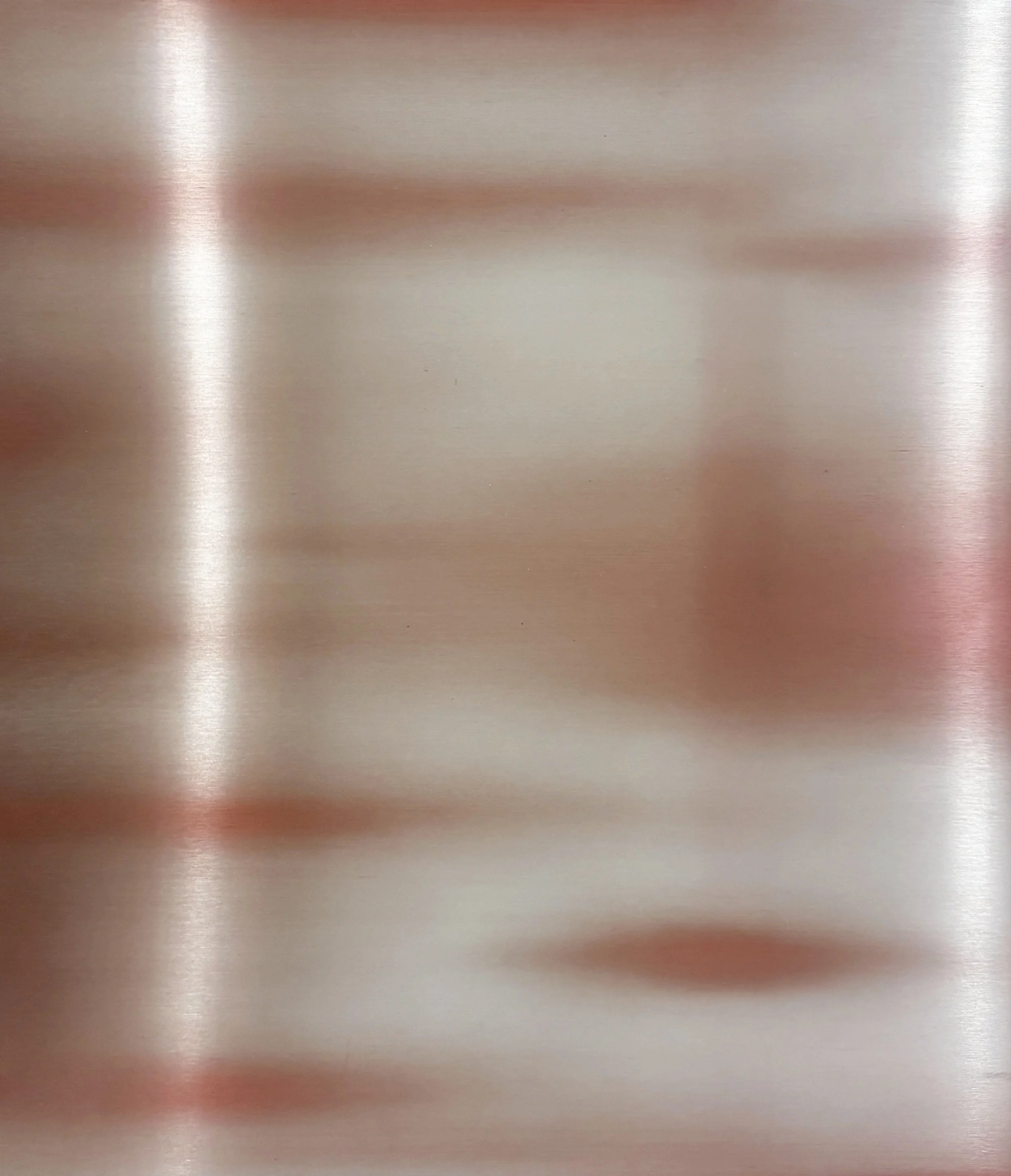
Flux Forma Megaflat extends Franklin Collao's investigation into color, light, and the physical surface of painting. Following the Flux Forma exhibition presented at Colector Dallas in 2025, this second installment raises the question concerning how flat can an oil painting be? Where Flux Forma deals with the way movement and light interact within a two-dimensional pictorial field, Flux Forma Megaflat involves the medium as an active participant in the works. The exhibition presents a new series of large-format works that engage energy, light sequences, solar eclipses, and explosions, moving swiftly between softness and endlessness.
Collao applies oil paint directly onto stainless steel sheets in exceptionally thin layers, creating a translucent chromatic film. Beneath the pigment, the mirrored metal reflects light and shadow, producing an interplay between painted color and the surrounding space. The result brings oil to a new extreme: the flattest surfaces the artist has made, non-porous and non-absorbent, eradicating volume, texture, and the familiar body of paint. The works look closer to airbrush than to oil, bidimensional, smooth, and nearly weightless. Achieving this required a highly complex process of adhesion between oil and metal, along with the deliberate erasure of brushstrokes and of any trace of how the paint was applied.
Produced entirely in Mexico City and influenced by its urban landscape, the series is related to the night, whereas the previous Flux Forma was heavily related to day and light’s reflection on water surfaces. All the works in this second part of the series are monochromatic in red tones, and their look is distinctly industrial. The combination of the cold, reflective metal and the red pigment sets human nature against industrialization, a tension that results in rich contrast. Collao describes the series as a dramatization of and a kind of manifesto for oil painting.
The works draw on modern art, in particular Donald Judd's Stacks and the minimalism of the 1960s. Where minimalism sought to reduce the human element, this series offers a nod to that legacy while keeping the artist's hand present in the process, even if invisible. The title also enters into dialogue with Takashi Murakami's “Superflat,” articulated in his 2000 manifesto, which connected historical Japanese art with manga, anime, and consumer culture and addressed both the compression of pictorial space and the flattening of hierarchies between fine art and popular imagery. The term "megaflat" continues that idea of "superflat" from the end of the 1990s, while here the emphasis falls on how oil paint can relinquish its density and texture while retaining its expressive force.
As the painted layer becomes thinner, the reflective support contributes more directly to what is seen. Physical flatness gives rise to impressions of depth and radiance, while changes in illumination and viewing position alter the relationship between color and reflection. The surface invites sustained looking, its appearance unfolding through the encounter between pigment, steel, light, and the observer.
The exhibition is divided across the gallery's two rooms, presenting two different moments of the same series. Works will also be produced on site in a mural style, and ready-to-go pieces will be displayed in the gallery’s shop room. Flux Forma Megaflat places painting at a threshold of material visibility. In reducing the substance of oil to a translucent veil, Collao opens the image to its surroundings, allowing a nearly weightless layer of color to activate the space around it.
Renata Kalife, Oct 2019